Downers Grove, IL · Garage Door Service
Installing a new garage door in Downers Grove means matching hardware to a house built between 1938 and 2003 and a track that has to hold up through a cold winter.
Most of the housing stock in this part of the western suburbs went up between 1938 and 2003, with a lot of it clustered in the 1960s and 70s across the dozens of named subdivisions and pockets that make up this area. That matters for installation because the opening sizes, header clearance, and stud spacing in a 1965 build are not what a door and track kit assumes today. A lot of installers show up with a standard 16x7 kit and force it into a frame that was never square to begin with, because the house has settled for fifty-plus years.
The climate here is the other half of it. This is a cold-moderate zone, which means the door has to seal against a real winter, not just look good in a showroom. On an older frame, a track that's slightly out of plumb will bind the moment the wood contracts in January cold. Homeowners call it a "new door problem" when it's really an old-house-plus-cold-snap problem. The fix at install time is shimming and squaring the jamb properly before the track ever goes up, not after the door starts sticking.
We've seen both ends of this: houses where the original 1972-era opening is dead square and takes a modern door with no fuss, and houses two doors down where nothing lines up. You don't know which one you've got until someone measures it with a level, not a tape measure.
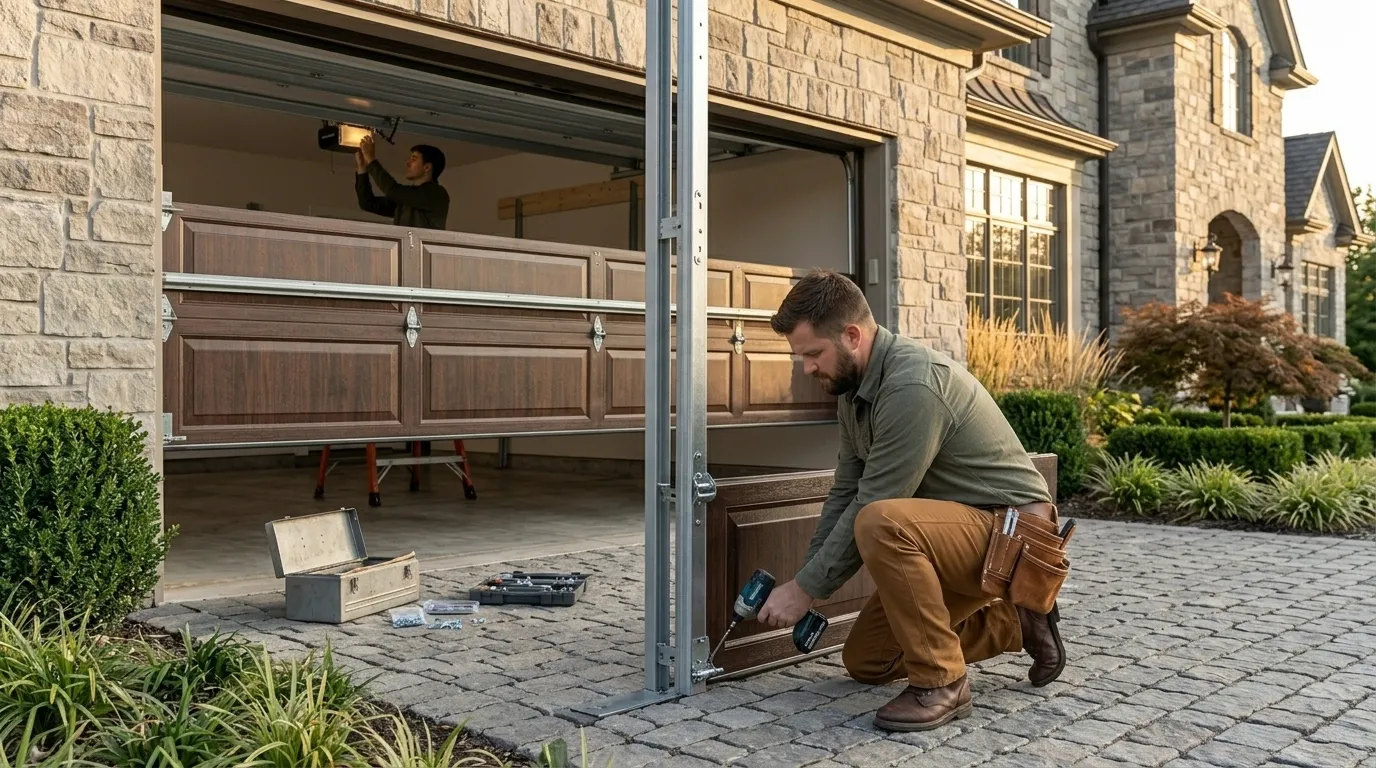
A lot of what you see on video makes installation look like a bolt-together job, and on a new-construction opening, it mostly is. On a house from the 1960s or 70s stock that's common around here, it's a different job. The header might not be doubled up the way current code expects, the jamb is often out of plumb by more than a hardware kit's shims can correct, and torsion spring tension has to be set to the actual door weight, not a number printed on a box.
We won't tell you it's impossible. If your opening is square, your studs are sound, and you're comfortable working with a wound torsion spring under load, a single-car door is a reasonable weekend project. Double doors and anything with a header that looks bowed or cracked, we'd tell a friend to call someone, because a spring that lets go under tension does real damage.
The honest limit here: we don't do consultations to "check your work" mid-project for free, and if you've already opened up the header and hit something unexpected, that's a different call than a scheduled install. Know that going in.
If you're pricing a new door because the old one won't seal, rattles going up, or looks warped along the bottom panel, what you're usually looking at is an original door from the 1972-median era of construction finally giving out. Steel doors from that period weren't insulated the way current ones are, and in a cold-moderate climate that means fifty winters of expansion and contraction have worked the panel seams loose.
Sometimes the door itself is fine but the opening has moved. Houses in this age range settle unevenly, especially where the garage was added or the driveway grade shifted over decades. You'll see this as a door that closes crooked, or that catches on one side of the track but not the other. That's not a door problem, that's a structural one, and no amount of new hardware fixes a jamb that's out of square.
Either way, before we quote installation we look at the opening itself: header condition, jamb plumb, and whether the slab has heaved at all. That tells us whether this is a straightforward swap or a job that needs framing work first.
The job goes sideways when someone measures the old door and orders a new one to match, without checking whether the opening itself is still square. On houses built across the 1938-2003 range that make up most of the local stock, five or six decades of settling means the frame you're installing into today is rarely the frame that was built. A door that's a perfect fit on paper ends up needing field trimming, extra shims, or in some cases a rebuilt jamb before it will operate right.
The other place it breaks down is spring sizing. A heavier insulated door, which most owners want given the cold-moderate winters here, needs different torsion spring tension than the steel door it's replacing. Reuse the old spring and the door either won't lift cleanly or will slam down, and that's a callback nobody wants.
We price the opening, not just the door, for exactly this reason. It costs more up front to check jamb and header condition before ordering hardware, but it's cheaper than a second visit to fix a door that never should have shipped in that size.
Check with a level on the jamb, not just a tape measure across the opening. On houses in this area built mid-century, out-of-plumb jambs are common after decades of settling. If the level shows more than a slight lean, get it measured professionally before ordering, since a door built to spec won't fit a frame that's shifted.
Yes. This is a cold-moderate climate zone, and a track or jamb that's even slightly out of square will bind once temperatures drop and wood or framing contracts. Getting the frame properly shimmed and squared at install time matters more here than in a milder climate.
On a square, sound opening it's doable for a single door. Homes from the area's common 1960s-70s stock often have headers or jambs that don't meet current framing assumptions, so if anything looks bowed, cracked, or out of plumb, that's a job for someone experienced with torsion spring tension and structural correction.
Usually it's the opening, not the door. An older frame that's shifted over fifty-plus years leaves gaps a new door's weatherstrip can't close on its own. That needs jamb correction, not a different door.
Call now or request a free quote - same-day service on most repairs, upfront written pricing.