Downers Grove, IL · Garage Door Service
Wood Dale's houses mostly date to the early 1970s, which shapes the springs, tracks, and openers we see on every call. Downers Grove Garage Door Pros makes the 12-mile run out here.
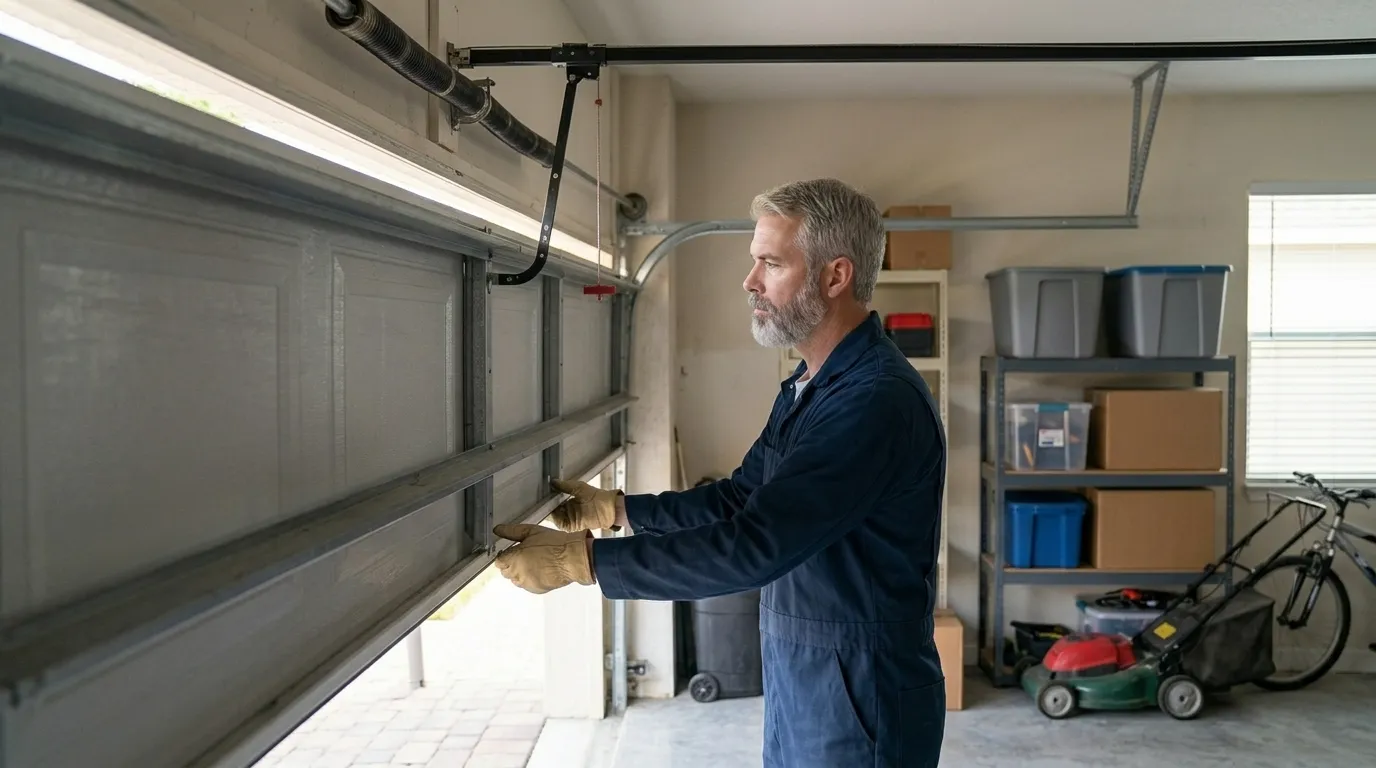
Wood Dale's housing stock centers on 1972, and that single number tells us most of what we need to know before we even load the truck. A door installed when a house went up in the early '70s is almost always a steel sectional on a torsion spring set above the opening, not the older side-mounted extension springs you'd find on something built before the war. The hardware from that era used lighter-gauge steel and smaller-diameter torsion springs than what gets installed today, which means the springs wear out sooner relative to a modern door and the drums that hold the cables are more prone to cracking after decades of cycling. We also see a lot of original wood jambs holding brackets that have loosened over fifty-plus years, which throws the whole track alignment off even when the springs and cables look fine. None of that is a defect specific to Wood Dale - it's just what happens to a door assembly left in place since Nixon was in office. Homeowners here often call about a door that's suddenly loud or uneven, and nine times out of ten the root cause traces back to original hardware that was never meant to last this long, not a manufacturing flaw in the door itself.
Across the wider service area, houses run anywhere from 1938 to 2003, with the bulk of that stock landing in the 1960s and '70s - and Wood Dale sits right in the thick of that band rather than at either edge. That matters because a street of homes built in the late '50s or early '60s often still has the original one-piece tilt-up door or an early sectional retrofit, while a street built closer to 2000 usually has an insulated steel door with a screw-drive or belt-drive opener already installed. On the older blocks we still find doors with no insulation at all, which in a cold-winter climate means condensation forming on the inside face of the door and rusting out the bottom panel from behind, invisible until it fails. On the newer end of the range, the failures are more about opener electronics and worn nylon rollers than structural steel. Knowing which decade a block was built in tells us before we arrive whether we're likely bringing torsion springs sized for a lighter door or dealing with a heavier insulated panel that needs different spring tension entirely. We don't guess at that on-site if we can help it - we ask when the house was built.
The typical Wood Dale garage from this era is a single or double bay built into a house that's now over fifty years old, with a stud-framed opening that's settled slightly out of square - common in a cold climate where frost heave shifts foundations a fraction of an inch a year. Doors from the early '70s construction wave were almost always plain steel, uninsulated, and hung on tracks bolted to wood framing rather than the reinforced steel jambs used in newer builds. That combination means the track brackets are often the weak point, not the door panel itself. We also see aluminum and wood doors on some of the older properties, both of which behave differently under cold-weather contraction than steel - wood swells and binds, aluminum can dent and throw the roller path out of true. None of this is unique to any one street; it's a function of building an entire neighborhood in a fairly narrow window of time using the materials and codes of that period. It's also why a repair that works on a newer door in a nearby subdivision sometimes doesn't translate directly to a house here - the hardware generation is different.
We run out of Downers Grove, about 12 miles from Wood Dale, so we're not sitting in a depot around the corner - we're making a dedicated trip for your call. That distance is worth being upfront about: it means we're not the outfit to call for a five-minute favor, but it also means the truck that shows up is set up to handle a full spring replacement or opener swap in one visit rather than requiring a second trip to get parts. We schedule the Wood Dale run with that travel time built in rather than treating it as an afterthought squeezed between closer jobs. One honest limitation - if a part isn't something we carry stocked on the truck, ordering it can add a day or two, and on an older torsion spring sized for a lighter '70s-era door, that's more common than it is on newer stock. We'd rather tell you that up front than have you wait on a promise we can't keep from 12 miles out.
Because a door and its hardware are sized and built to the codes and materials available when the house went up. Most Wood Dale homes date to around 1972, so the springs, tracks, and panel gauge on an unreplaced door are early-'70s hardware - lighter and more worn than what you'd find in a house built in the last twenty years.
No. We're based in Downers Grove, about 12 miles away, and we drive out for each job. There's no local depot here, so we build the travel time into scheduling rather than treating Wood Dale calls as an afterthought.
Depends what's failed. A worn spring or cracked roller on an otherwise sound '70s-era steel door is usually worth fixing. If the panel itself is rusted through from decades of uninsulated condensation, replacement often makes more sense than patching a door that's outlived its hardware anyway.
Older streets more often have original torsion hardware and track brackets bolted into wood jambs that have loosened over fifty-plus years. That looseness shows up as noise and uneven travel even when the springs and cables themselves are still functional.
Call now or request a free quote - same-day service on most repairs, upfront written pricing.