Downers Grove, IL · Garage Door Service
Lisle's houses run newer than most of the Downers Grove service area, and that changes which rollers wear out first. Here's what actually fails and why.
Downers Grove Garage Door Pros covers Lisle from about 3 miles out, and the first thing that separates a Lisle roller call from one closer to the older parts of the wider service area is the age of the house. Across the broader Downers Grove service area, the median home dates to 1972, with stock going back to 1938. Lisle runs newer - median build year 1982. A ten-year gap doesn't sound like much until you're standing in front of the track. Doors installed in the early-to-mid '80s came with different roller stems, different track gauge, and different drum hardware than the ones from the '60s and early '70s that dominate older pockets of the service area. When a roller job "goes sideways" in Lisle, it's almost always because someone brought parts sized for the older stock and they don't sit right in an '80s track. The fix isn't different in kind, but the parts call is different, and that's the part that trips people up before the truck even leaves Downers Grove.
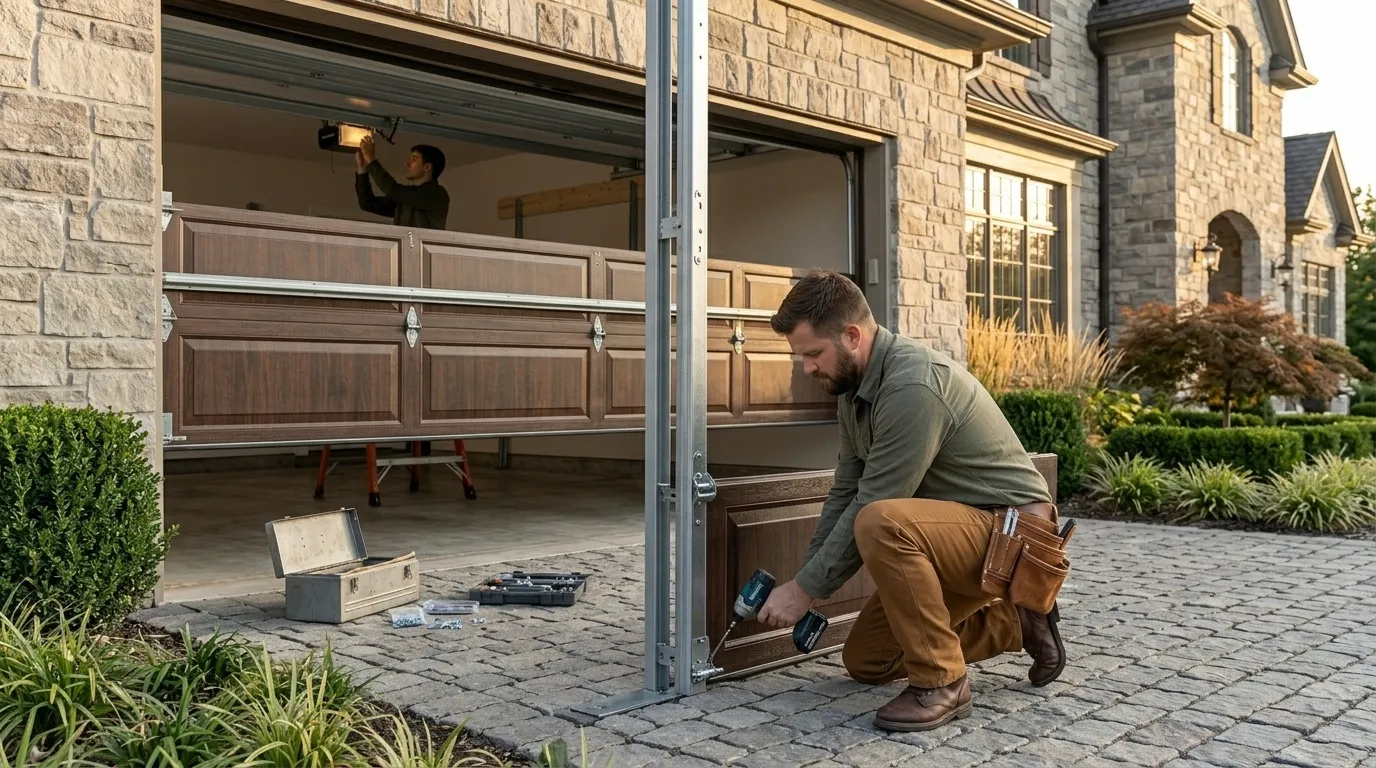
Roller replacement on an '80s-built door in Lisle usually means pulling the whole set - ten or twelve rollers per door - rather than swapping the one or two that are grinding. If one nylon roller has worn through its stem, the others on that track are close behind; they've done the same number of open-close cycles. The job involves releasing tension on the door (with the springs, not against them), sliding the old rollers out of the track sections, and fitting new ones - usually nylon with sealed bearings for a quieter ride, sometimes steel where the door sees heavier daily use. Track alignment gets checked at the same time, since a bent section will chew through a new roller just as fast as it did the old one. On a standard double door this is a controlled, methodical job, not a rush. We don't quote a fixed time for it here - that number depends on what the track looks like once the panel's open, and guessing it before the truck is on site would be the wrong kind of promise.
Swapping a single bottom roller on a door that's already open and stable is within reach for a patient homeowner with the right hex-stem roller in hand. What isn't a DIY job is anything involving the springs - releasing torsion tension incorrectly is how people end up in the emergency room, not just with a bent bracket. If your Lisle door is sagging unevenly, binding partway up, or the track has visibly pulled away from the frame, that's a spring or hardware issue riding along with the roller wear, and it needs someone who's done the release before. Our honest limit here: we don't talk anyone through a torsion release over the phone, and we won't quote a same-day fix sight unseen. If it's just rollers and the door's otherwise sound, a confident DIYer can handle it. If you're not sure which situation you're in, that uncertainty is itself the answer - call it in.
A grinding or rattling sound as the door travels, worse at the top or bottom of the run, usually means a roller bearing has gone dry or cracked. On '80s-era Lisle doors, the giveaway is often a slight hop or shudder right where the curved section of track meets the vertical run - that's a nylon roller losing its round shape and catching the bend. Flat spots on the roller face show up as a rhythmic thump, once per rotation, that gets faster as the door opens. If you see grease or black residue collecting on the track near the rollers, that's the old lubricant breaking down under a cracked bearing, not a leak from anything else. None of this is dangerous to watch happen, but it accelerates - a door that's noisy in spring is often binding by fall, especially once cold sets in and the nylon stiffens further.
The service area sits in a cold-moderate climate band, and nylon rollers stiffen and crack faster in the cold swing between a warm garage interior and a frozen slab underneath it. That's true everywhere in the area, but it hits Lisle's stock in a specific way: with roughly 10,022 households and a housing base that's mostly single-family and built in one fairly tight window, a lot of these doors are working through their original hardware at close to the same age, all at once. It isn't a coincidence when three calls in a week come out of the same few Lisle streets - it's the same batch of nylon aging out together. Household income here runs higher than the broader service area's median of $90,408, at $106,173, which tends to mean owners replace the full roller set rather than patch one at a time - a decision that actually saves a second truck trip a year or two later.
Often, yes. Lisle's housing stock runs newer than most of the broader service area - median build year 1982 versus 1972 for the wider area. Doors from that later build tend to use different stem sizes and track gauge than the '60s and early-'70s stock nearby, so we bring parts matched to the era, not a one-size kit.
No. We run out of Downers Grove and cover Lisle from about 3 miles out. There's no local depot or drop-in counter here - every roller job is a scheduled truck visit from Downers Grove.
You can, and for a single fresh failure that's sometimes the right call. But if the door is original to an early-'80s Lisle build, the other rollers are the same age and close to the same wear. Most owners here end up doing the full set once one has failed.
It's a factor. The area sits in a cold-moderate climate band, and nylon rollers stiffen in the swing between a heated garage and a cold slab. It's not the only cause of wear, but it speeds up cracking that's already started from age and cycle count.
Call now or request a free quote - same-day service on most repairs, upfront written pricing.